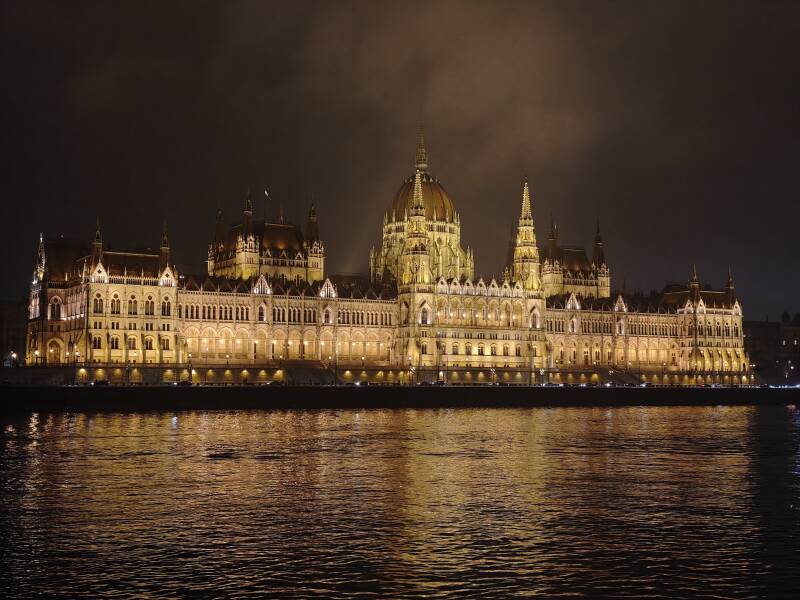
On the 12th April, 2026 the Hungarian people voted to remove Viktor Orbán, ending his 16 year ‘electoral autocracy’. Péter Magyar, leader of the Tisza Party claimed a decisive victory, now holding 138 out of the 199 in the Hungarian Parliament. This is an incredible mandate, with record breaking turnout of 79.5%. Subsequently sworn in of the 9th May, Magyar invited Hungarians to “step through the gate of regime change”. With this decisive victory representing a significant shift away from the right-wing populism that has gripped Hungary for nearly two decades, the question remains. How did Magyar fight against the entrenched power of the Fidesz Party which has for years limited press freedom and constrained the voices of opposition forces? Furthermore, if a centrist, pro-European political leader can win such a mandate against right-wing populism, can other European leaders learn from this experience in their fight against their own ‘Viktor Orbáns’.
Which Issues Defined this Election?
To contextualise the scale of Magyar and Tisza’s win, it is important to explore the institutional authoritarian policies they were fighting against. One of Fidesz’s earliest crackdowns was on the judicial system. In 2012, Orbán’s government reduced the compulsory retirement age for judges, forcing almost 300 senior members of the judiciary from office. Authority over appointing their replacements was then concentrated in the hands of a single political appointee, the wife of a founding member of Fidesz. This is just one example of the rampant cronyism that characterised Orban’s leadership. Furthermore, Orbán moved quickly to rewrite Hungary’s constitution and restructure the country’s electoral system in ways that strengthened Fidesz’s representation in parliament. Those reforms helped entrench the party’s dominance, despite receiving as little as 44% of the national vote, Fidesz has previously secured a two-thirds parliamentary majority in every election since 2010. Hungary’s system, in which parties rather than voters choose parliamentary candidates, has further consolidated Orbán’s influence over the composition of government. In addition, Under Orbán, the government tightened its control over the media through a series of new laws, while a number of independent outlets were either closed or acquired by businessmen aligned with the regime. Unfortunately, defining his party as the one true representative of the ‘Hungarian people’ against a ‘corrupt elite’, over time, Orban forgot not to create his own corrupt elite at the heart of the government. A particular catalyst for declining public trust was in 2024 when the Orban government pardoned a deputy director of a children’s home convicted of a paedophilic abuse cover-up, shattering the government’s image as a protective, moralistic defender of children and traditional values. The right-wing populist playbook of autocratic-style leadership eventually came back to bite Orban. The control of the media, manipulation of the judiciary and constitution snowballed into widespread public mistrust of Orban and his cronies.
Despite a campaign shaped by state-controlled media, pro-Orbán messaging and disinformation, as well as external backing from both Russia and the Trump camp, including the dispatch of JD Vance and the offer to Orbán of a supposed “direct line to the White House”, Hungarian voters turned out in large numbers on 12 April to remove the incumbent government. They instead backed centre-right challenger Péter Magyar, whose campaign centred on anti-corruption, democratic renewal and dismantling the Orbán system.
How did Magyar Win Over the Hungarian People?
Magyar brought solutions to the voters. Instead of patronising or condemning Fidesz supporters, his campaign opened a constructive dialogue with opposition forces, listening to concerns. Magyar visited 161 out of 174 parishes in the country and appeared in 327 towns, sometimes visiting up to nine in one day. Magyar's campaign was defined by a disciplined and persistent focus on two key topics: the corruption inside the Orbán government, and Hungary's related, very poor economic performance. This laser-focus was not accidental. Rather than scattering the anti-Orbán vote across a fragmented opposition, Magyar consolidated it. By concentrating the challenge around one serious alternative, the contest felt like a real choice rather than a protest gesture, and because that alternative was strong enough to win a supermajority, it created the possibility of rolling back the machinery Orbán had built.
Magyar's credibility on corruption was also uniquely personal. His break from Fidesz was catalysed by a recorded conversation with his ex-wife, Judit Varga, revealing interference in a corruption case, the incident that first brought him to public attention. This gave him an authority on the subject that career opposition politicians lacked. Tisza's anti-corruption programme went further than rhetoric, incentivising members of the public to report fraudulent government behaviour anonymously online, and Magyar pledged that a Tisza government would review every public contract and trace every suspicious financial transaction. Crucially, the campaign linked corruption not to abstract democratic principles but to the practical, material costs borne by ordinary Hungarians, a framing that proved more persuasive than moral outrage alone.
One of the most significant structural obstacles Magyar faced was Orbán's control of the Hungarian media landscape. Magyar was effectively barred from appearing on state media for the eighteen months of his campaign, while Tisza built a commanding lead in the polls. Unable to access traditional broadcast channels, Tisza relied on a combination of social media and direct grassroots organising. Following Tisza's second-place finish in the 2024 European elections, Magyar called supporters to establish local associations dubbed "Tisza Islands", a reference to Hungary's longest river. Around 1200 such groups were established, including in rural areas the old opposition parties had effectively abandoned, organising community events before switching to full-time campaigning. Tisza set a target of three volunteers per polling station catchment area, requiring approximately 30,000 people. The party reported that 50,000 volunteers were mobilised across the campaign. Local affiliates also helped select district candidates through intra-party primaries, and Magyar brought in respected figures from business, including executives from Shell, Erste and Vodafone, to lend the party credibility beyond the political class. The campaign also had to contend with coordinated disinformation. Researchers at the Gnida Project linked fabricated videos and smear campaigns targeting Tisza to Storm-1516, a Russian disinformation group previously identified in the US and German elections. That Tisza overcame this, in addition to the domestic state media apparatus, underlined the effectiveness of its ground operation.
Furthermore, another central feature of Magyar's campaign was its deliberate targeting of Fidesz strongholds rather than consolidating support in Budapest and larger cities where Tisza was already strong. Analysis of Magyar's campaign stops shows that the tour targeted competitive districts where the two parties were more evenly balanced, bypassing Budapest and concentrating instead on Fidesz heartlands in the countryside. The key to winning over Fidesz-leaning voters was not to attack their previous political choices, but to speak directly to the economic realities of their lives. Magyar's central message was that corruption had cost Hungary EU funding, and that the resulting damage translated directly into declining living standards, deteriorating healthcare and education, and diminished prospects for their children. Rather than framing this as an argument about democracy or European values, abstractions that had failed to move many Fidesz voters in previous elections. Instead, Tisza made the case in explicitly material terms. Even the cash incentives and social benefits that Fidesz had habitually distributed ahead of elections appeared less effective this time, as many voters began to question why economic returns appeared to benefit Orbán's elites more than ordinary citizens.
The Tisza Islands network reinforced this message at ground level. Volunteers organised local community events, charity drives, cookouts, political discussions, before switching to full-time campaigning, with small and medium-sized businesses playing a key role in the movement. This gave Tisza a visible presence in communities where the old opposition had been effectively absent. The electoral data bears out the effectiveness of this approach. Fidesz's vote share collapsed by 17 percentage points in settlements of under 10,000 people, precisely the rural communities it had dominated for over a decade, where it had previously commanded vote shares of between 60% and 68%. Even in its smallest strongholds, villages of under 500 people, Fidesz fell from 68% in 2022 to just 51% in 2026, with Tisza taking 41% of the vote. In larger towns and cities of over 50,000, the picture was even starker: Fidesz dropped from 44% to 31%, while Tisza secured 61%. The uniform nature of these losses across every settlement size, a consistent 13 to 17 percentage point decline, suggests that Tisza's gains were driven not merely by mobilising existing opposition voters, but by winning over a significant portion of those who had previously backed Fidesz.
Ultimately, Tisza's victory was not simply the product of anti-Orbán sentiment, but of a campaign that succeeded where previous opposition efforts had failed. They successfully converted dissatisfaction into a credible governing alternative. By linking corruption to everyday economic decline, building a grassroots presence in communities long abandoned by the opposition, and directly contesting Fidesz on its own terrain, Magyar transformed the election from a referendum on Orbán into a genuine contest for power. The scale and consistency of Fidesz's losses across both rural and urban Hungary suggest not merely electoral fatigue, but the erosion of the social coalition that had sustained Orbánism for more than a decade.
What can the UK and Europe Learn From this Incredible Victory?
Magyar’s victory has significance beyond Hungary. From the AfD in Germany, Law and Justice in Poland, Reform UK in Britain and many more, European countries are facing battles against similar right-wing populism that risks bringing a similar Orban-style autocratic governance across the continent. Magyar’s victory represents the potential beginning of a widespread shift away from that kind of politics.
In the United Kingdom, Nigel Farage's Reform UK has capitalised on similar public disillusionment to the Fidesz Party. Reform polled first in the 2026 local elections, gaining over 1,400 council seats. The ideological links between Reform and Orbán's Fidesz are also well-documented. Senior Reform figures have held positions at Orbán-funded organisations, appeared on Orbán-backed platforms and repeatedly praised his government and Farage expressed admiration for Orbán publicly as far back as 2018. The defeat of Orbán is therefore directly relevant to those seeking to understand and counter Reform's rise.
Several of Magyar's strategic choices offer clear lessons. First, message discipline. The mistake of focusing on exposing the hypocrisy of the populist right is that it is insufficient on its own. What seems to have mattered most is demonstrating the practical failures of hard-right governance, linking it to the cost to voters of crumbling public services, stagnation and corruption. Second, geographic reach, Magyar's decision to campaign in rural and small-town Hungary directly challenged the assumption that these communities were irretrievably lost. By 2026, Fidesz's vote share had collapsed not only in cities but across rural settlements where it had previously been strongest. Many of the equivalent communities in the UK, post-industrial towns and coastal areas, have seen similar patterns of abandonment by mainstream parties that Reform has been quick to exploit. Third, consolidation. Magyar succeeded in part because he offered voters a single credible alternative rather than a fractured opposition, a particular challenge in the UK's multi-party landscape but one that the electoral system itself may help resolve. Magyar managed to highlight the problems with Orban’s authoritarianism, corruption and pro-Russian attitudes whilst maintaining it’s relevance to people’s everyday lives and experiences. With Reform UK facing half-hearted media scrutiny as to it’s involvement with Russian money, undeclared foreign donations and political partiality via GB News that seemingly goes unpunished by OFCOM, mainstream parties in the UK have the opportunity to capitalise on this shirking of the rules, strategically focusing on how this behaviour in government risks the same corruption that caused economic problems in Hungary.
Another important lesson to be learnt within Magyar’s victory is the coalition of parties he was able to build, as well as the non-patronising or exclusionary attitude his campaign took towards Fidesz supporters, which managed to convince so many that Orbán’s autocratic, ‘illiberal democracy’ was not the only option. Rather than condemning or dismissing rural Fidesz voters, Magyar travelled extensively through pro-Fidesz areas, holding town hall meetings and local discussions where he listened directly to concerns surrounding inflation, healthcare, wages and corruption, treating voters as people to persuade rather than enemies to defeat. The UK and other European governments must similarly listen to the disillusioned, identify why they have failed to maintain the trust of the people convinced by the glamour of far-right populists, and put this into action through practical solutions and messages of hope that things can be better within democracy. If not, the UK and Europe risk falling into the same autocratic, oppressive governance the Hungarian people were trapped within for nearly two decades.
Add comment
Comments